



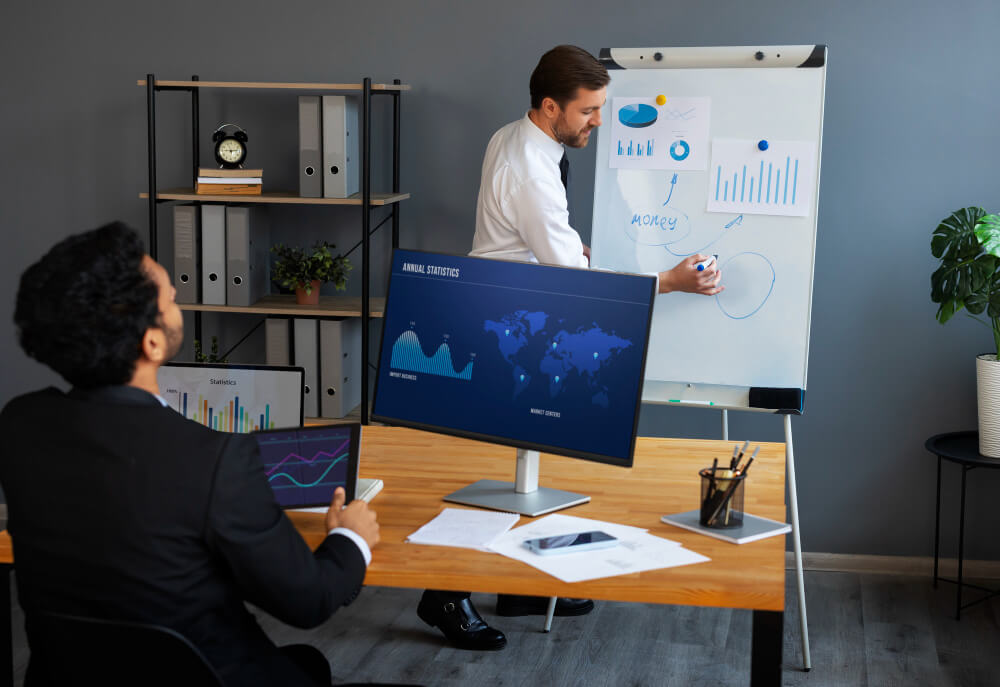

Running a small business means making important decisions every single day often with limited resources, limited time, and very little room for error. Owners and managers are expected to plan strategies, manage finances, train teams, and adapt to market changes, all while keeping operations running smoothly. This is where Business Simulations are becoming a powerful and practical solution for small businesses that want to learn faster and perform better without risking real money or reputation.
Instead of relying only on theory, guesswork, or costly trial-and-error, business simulations allow small business teams to experience realistic business scenarios in a controlled, risk-free environment. These simulations help bridge the gap between learning and doing, making them especially valuable for small organizations that need practical results, not just ideas.
What Are Business Simulations?
Business simulations are interactive learning tools that replicate real-world business situations. They place participants in realistic roles such as business owners, managers, or team leaders and challenge them to make decisions related to finance, marketing, operations, leadership, or strategy.
Unlike traditional training methods like lectures or static courses, business simulations are dynamic. Every decision made by the participant leads to consequences, just like in a real business. If pricing is set too high, sales may drop. If inventory planning is poor, cash flow problems may appear. Participants learn not just what to do, but why certain decisions work better than others.
For small businesses, simulations often focus on practical challenges such as managing cash flow, growing a customer base, improving team productivity, or responding to competitive pressure.
Why Business Simulations Matter for Small Businesses
Large corporations often have the luxury of extensive training programs, consultants, and experimentation budgets. Small businesses, on the other hand, usually operate with tight margins and small teams. One wrong decision can have a significant impact.
Business simulations matter because they level the playing field. They give small businesses access to high-quality, experience-based learning without the high cost or risk. Teams can practice decision-making, understand cause-and-effect relationships, and improve performance before applying changes in the real business.
Most importantly, simulations help small businesses shift from reactive decision-making to strategic thinking something that is essential for long-term growth.
Challenges Small Businesses Face in Training and Skill Development
Training is often one of the first areas small businesses struggle with. Common challenges include:
-
Limited budgets that make expensive courses or consultants unrealistic
-
Time constraints, as employees already juggle multiple roles
-
Lack of structured learning, leading to inconsistent skill development
-
Difficulty translating theory into practice
Many small business owners rely on on-the-job learning, which can work but it often leads to costly mistakes. Without a safe place to practice skills, employees learn only after something goes wrong.
Business simulations directly address these challenges by providing structured, engaging, and practical learning experiences that fit into the realities of small business life.
The Value of Simulation-Based Learning for Limited Budgets
One of the biggest advantages of business simulations is cost efficiency. Traditional training methods may require travel, instructors, or long hours away from work. Simulations, especially digital ones, are often scalable and reusable.
For a limited budget, simulation-based learning offers:
-
High learning impact at a lower cost
-
Reusable training for multiple employees
-
No disruption to real business operations
-
Measurable learning outcomes
Instead of paying for repeated training sessions, small businesses can invest once and continuously develop their teams. This makes simulations a smart long-term investment rather than a one-time expense.
How Business Simulations Provide Practical, Hands-On Experience
Learning is most effective when people actively participate rather than passively listen. Business simulations are designed around this principle.
Participants are required to:
-
Analyze data
-
Make decisions under pressure
-
Balance short-term results with long-term strategy
-
Work individually or as a team
Because simulations mirror real business conditions, learners develop practical skills they can immediately apply. Concepts like cash flow management, customer acquisition, operational efficiency, and leadership become clearer when experienced firsthand.
This hands-on approach improves retention, understanding, and confidence especially for employees who learn best by doing.
Risk-Free Environment for Testing Strategies and Decisions
In real business, testing a new strategy can be risky. A pricing mistake, marketing misstep, or operational error can cost money and damage relationships. Business simulations remove that risk.
Within a simulation:
-
Mistakes are safe and valuable learning opportunities
-
Teams can test multiple strategies and compare outcomes
-
Participants can explore “what-if” scenarios without consequences
This encourages experimentation and creative thinking. Employees become more willing to take initiative and propose new ideas because they have already practiced decision-making in a safe environment.
Over time, this builds stronger problem-solving skills and better judgment across the organization.
Specific Benefits for Small Business Teams and Managers
Business simulations don’t just benefit individuals they strengthen entire teams and leadership structures.
For Teams:
-
Improved collaboration and communication
-
Better understanding of how different roles impact the business
-
Stronger accountability and ownership
For Managers:
-
Sharper strategic thinking
-
Better decision-making under uncertainty
-
Improved ability to coach and guide teams
Managers can also observe how employees think, react, and lead within simulations, making it easier to identify future leaders or training needs.
How Platforms Offering Business Simulations Can Accelerate Team Performance
Modern platforms offering business simulations go beyond simple exercises. Many provide analytics, feedback, and performance tracking that help businesses measure progress.
These platforms can:
-
Customize simulations based on industry or business size
-
Track decision patterns and learning outcomes
-
Provide insights into strengths and weaknesses
-
Support remote or hybrid teams
For small businesses, this means faster skill development, more aligned teams, and better overall performance without adding complexity or overhead.
When used consistently, simulation platforms can become a core part of a company’s learning and development strategy.
Conclusion
Small businesses operate in an environment where every decision matters. Limited budgets, small teams, and high competition leave little room for error. Business simulations offer a practical, affordable, and highly effective way to build skills, test strategies, and develop confident decision-makers.
By providing hands-on experience, a risk-free learning environment, and measurable results, business simulations help small businesses train smarter not harder. Whether used for leadership development, team training, or strategic planning, simulations can play a key role in long-term business success.
For small businesses looking to grow sustainably, adapt quickly, and compete effectively, business simulations are no longer a luxury they are a strategic advantage.