



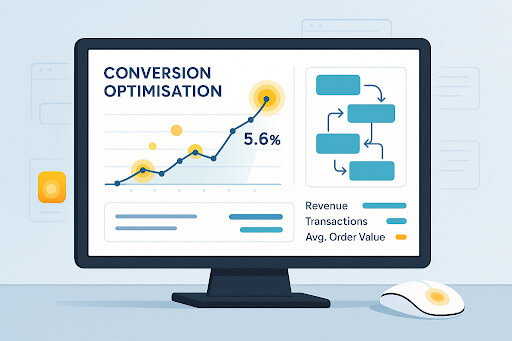

If you are running a website and not seeing the revenue you expect, you are not alone. In fact, roughly 87 % of websites fail to convert a meaningful proportion of their traffic into revenue. That means almost nine out of ten sites are missing the mark.
Traffic alone is not enough. What really matters is conversion turning visitors into leads or buyers. You could have thousands of visitors daily, yet if they leave without acting you get zero value.
In this post we will explore exactly why most websites under-perform and share proven fixes used by high-performing UK brands to boost conversion and revenue.
Real Reasons 87 % of Websites Fail to Convert
Most websites do not fail because of a single flaw. They fail because multiple small issues accumulate and create friction at every stage of the user journey. Visitors make rapid decisions based on clarity, ease of use, relevance and trust. When any of these elements are weak, conversion rates fall quickly. Many of these issues can be prevented through structured optimisation and the right Web Development Solutions that remove friction early in the visitor experience. The following factors represent the most common and costly issues that hold websites back.
Reason #1: Poor First Impressions and Weak UX
Visitors form an opinion rapidly — often within a few seconds. If your site loads slowly, has confusing layout or visual clutter, you have already lost attention. On mobile especially the tolerance is low. A weak user experience means visitors struggle to find what they want, feel friction in navigation or checkout, and leave.
Reason #2: No Clear Value Proposition
When someone lands on your homepage they should immediately understand what your business offers, the benefit to them, and what differentiates you. If that clarity is missing, you waste the opportunity to engage interest. That confusion leads to bounce, not engagement, and certainly not conversion.
Reason #3: Weak or Buried Calls to Action
Having a call to action (CTA) is one thing; making it visible, relevant and compelling is another. Generic CTAs like “Click Here” or hidden buttons fail. If your visitor is ready to act and they cannot find the path, the conversion is lost. Effective CTAs are placed where they are expected, stand out visually and communicate the benefit of the action.
Reason #4: Trust Deficit
Most visitors do not convert simply because they do not trust the site or the brand yet. They look for signals like social proof, credible testimonials, secure payment badges, or transparent pricing. Without those, hesitation wins. In the UK context where online shopping standards are high, missing trust indicators are a major barrier.
Reason #5: Mobile Experience Failures
Mobile traffic is ubiquitous but mobile conversions consistently lag. That benchmark drop to 1.8 % on mobile versus 3.9 % on desktop demonstrates the issue. Businesses often treat mobile as secondary. Poor navigation, long forms, unresponsive layouts — these create friction and kill conversion.
Reason #6: Content That Doesn’t Drive Action
Even with traffic, when content is dense, generic or misaligned with visitor intent, it fails to move people toward conversion. A visitor needs clear structure, value-driven messaging and direction to act. Walls of text, vague benefits or weak logical flow will lose them. Content must be crafted to educate, persuade and guide toward conversion rather than simply fill the page.
What High Performing UK Brands Do Differently
High performing UK brands approach their websites as active revenue systems. They refine user behaviour patterns, reduce unnecessary interaction cost and build every page to support a specific conversion intent. Their decisions are based on continuous data rather than assumptions.
They Design Experiences That Reduce Friction and Increase Action
These brands apply consistent visual hierarchy, fast load performance and intuitive layout flow. Every interface element has a defined purpose. This reduces cognitive effort and helps visitors reach key actions faster.
They Communicate a Clear Value Proposition Within Seconds
A visitor should understand the offer, the benefit and the differentiation immediately. Successful UK brands focus on clarity in the primary viewing area. They simplify the message so a first time visitor can connect value to need without scrolling.
They Establish Trust at Every Step
Trust shapes behaviour. High performing sites place credible reviews, recognised accreditation, industry logos and transparent policies exactly where visitors expect reassurance. This reduces hesitation and increases the likelihood of meaningful engagement.
They Use Context Driven Calls to Action
Their calls to action match the visitor intent of each page. The wording is specific and benefit led, and the placement follows natural reading patterns. This alignment produces higher click through rates because the action feels relevant rather than disruptive.
They Prioritise Mobile First Interactions
Mobile traffic continues to dominate, yet mobile conversion often underperforms. Top UK brands solve this by simplifying menus, removing unnecessary input fields, improving touch accuracy and ensuring fast rendering on smaller screens. The result is a smoother and more consistent mobile journey.
They Use Data as a Continuous Improvement Engine
Nothing is static. These brands use heatmaps, scroll depth reports, visitor recordings and controlled A B tests to validate decisions. They refine layout, messaging and interaction patterns based on observed behaviour. Over time this continuous iteration increases conversion efficiency across the entire site.
Proven Fixes You Can Implement Today
You can adopt many of the techniques used by top UK brands without a complete redesign. The following improvements directly address the issues that prevent most websites from converting.
Reduce Interaction Cost and Improve Load Performance
Remove unnecessary interface elements, simplify navigation and eliminate excessive clicks. Faster page rendering and cleaner structure improve user flow and directly support higher conversion.
Define Your Value Proposition in One Precise Sentence
State what you offer and why it matters in the first viewing zone. This reduces confusion and increases the chance that a new visitor will engage rather than exit.
Place Trust Signals Where Decisions Are Made
Add reviews, recognised certifications and security indicators at the points where users typically feel uncertainty. This reinforces credibility and reduces abandonment.
Strengthen Calls to Action With Intent Driven Language
Use clear action phrases that match the purpose of the page. Ensure your primary call to action is visible, predictable and positioned where attention naturally flows.
Remove Mobile Friction Points
Shorten forms, improve button spacing, and eliminate interactions that require unnecessary precision. If you are updating your mobile experience, this is an ideal moment to consider modern Web Development Solutions that support consistency across all device types.
Conclusion
Most websites do not fail because of a lack of traffic. They fail because visitors encounter friction, confusion or a lack of trust before they can take meaningful action. The data supports this. Average website conversion rates remain low across most industries, which means the opportunity lies in improving experience rather than chasing more visitors.
High performing UK brands succeed because they treat their websites as living systems. They focus on clarity, speed, trust and behaviour driven design. They measure what matters, simplify what slows visitors down and refine the path to action through ongoing validation.
Any organisation can apply these same principles. When the user journey becomes easier to understand and easier to complete, conversion increases naturally.